Reverse Osmosis Systems in Freedom, CA
Under-sink drinking water systems, installed tidily and serviced properly — with a straight answer on what they do and do not fix.
What it does, plainly
A reverse osmosis system sits under the kitchen sink and pushes water through a membrane fine enough to strip out most of what is dissolved in it. You get a separate small tap at the sink for drinking and cooking water.
It genuinely improves taste and clarity, and it removes a broad range of dissolved solids. It is the right tool if what you want is better water in a glass.
It is not a whole-house solution and it will not protect your plumbing. It treats a few gallons a day at one tap. If your problem is scale on the fixtures and water heaters dying early, that is a water softener question, not an RO one. Plenty of houses here run both — softener on the whole house, RO at the kitchen sink — and the two do different jobs.
Worth knowing before you buy one
- It is slow, and that is fine. RO produces water gradually into a storage tank, which is why there is a tank under the cabinet. You are not waiting at the tap.
- It sends some water to drain. Modern units are far better about this than they used to be, but a portion goes down the waste line. Ask about the ratio.
- Filters are a running cost. Sediment and carbon prefilters roughly annually, membrane every few years depending on your water. Skipping them does not just reduce performance — a fouled membrane fails early, and it is the expensive part.
- Hard water shortens membrane life. If you have a softener ahead of it, the membrane lasts noticeably longer.
How I install it
Under-sink cabinets get cluttered fast, and a bad RO install is a knot of tubing you cannot service without pulling everything out. So:
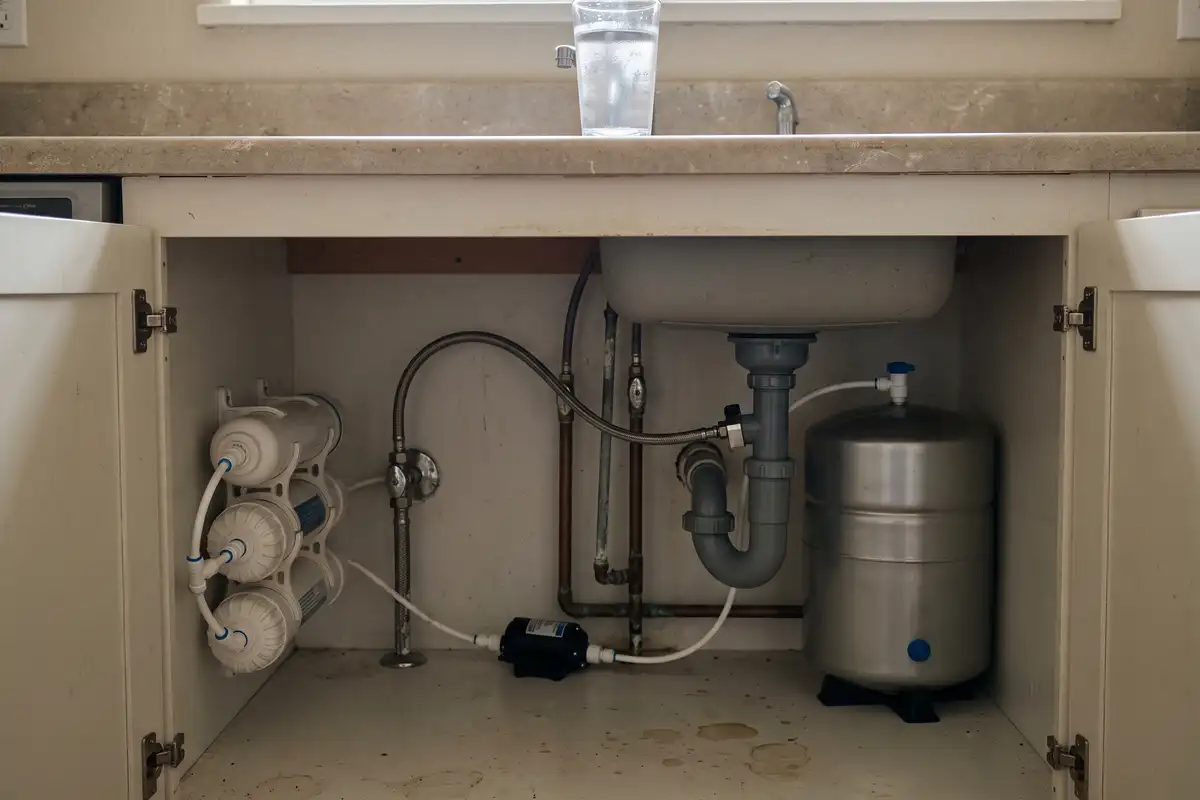
- Filter housings mounted to the cabinet side wall, not left lying on the base, with clearance underneath to actually change them
- Tubing routed and clipped, cut square, seated fully in the fittings
- Storage tank standing upright at the back where it is out of the way
- A dedicated feed connection at the cold supply with its own shutoff
- The drain saddle fitted properly and above the trap weir, so waste cannot siphon back
- The air gap or drain connection done to code
Then I run it, check every fitting under pressure, and show you which filter is which and how to change them — because if you know how, you will keep on top of it, and that is what determines whether the system is still good in five years.
Servicing an existing system
Common complaints I get called for, all fixable:
- Slow or trickling flow — usually the tank has lost its air charge, which is a five-minute fix, or the prefilters are overdue
- Water tastes off again — carbon filter exhausted
- Constant draining sound — a failed check valve or shut-off valve
- Leaks under the cabinet — nearly always a tubing end that was not seated fully when it was installed
I will service a system I did not install. If it turns out the unit is genuinely worn out I will say so, but most of what I see just needs filters and a proper going-over.
Covering Freedom, Watsonville, Aptos and Santa Cruz.