Leak Detection in Freedom, CA
Acoustic line locating for slab, underground and in-wall leaks — finding it precisely before anything gets opened up.
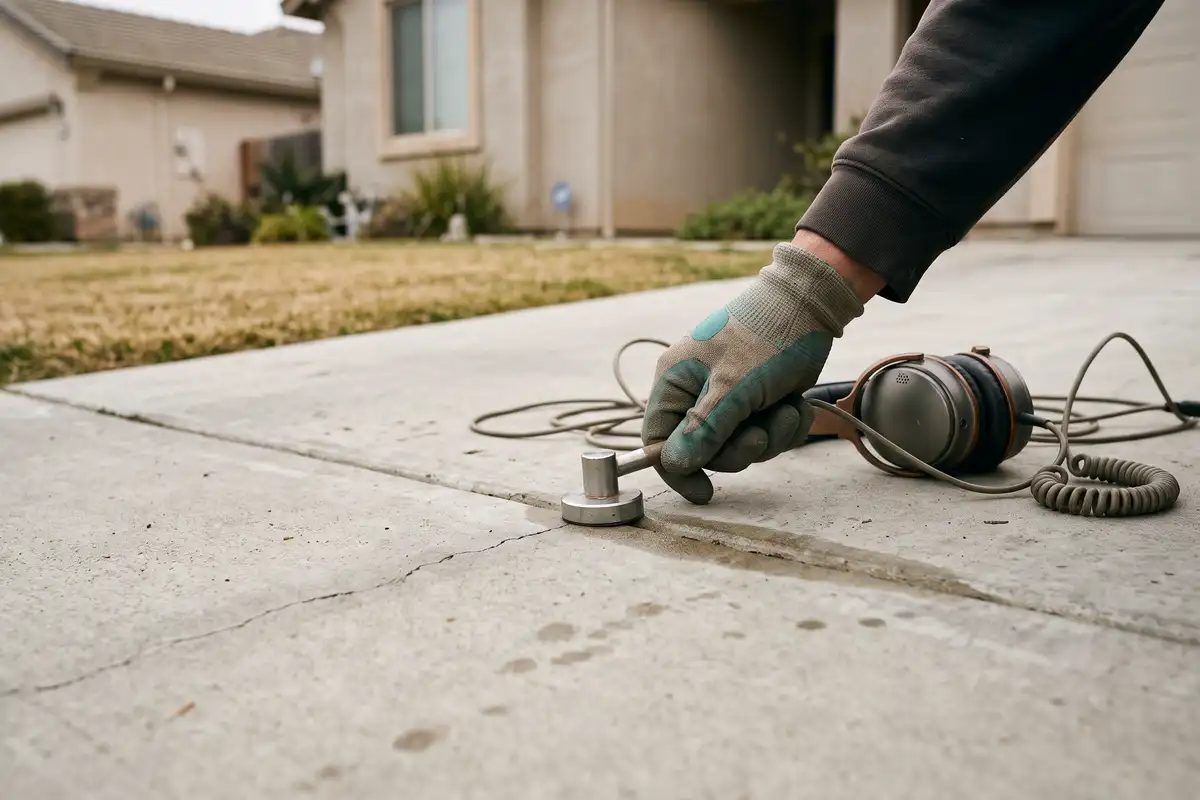
Finding it before you open anything
The expensive part of a hidden leak is rarely the repair. It is the demolition — concrete cut, drywall opened, landscaping dug up — looking for something that turns out to be four feet to the left.
So the whole job here is precision. I locate the leak acoustically first, mark it, and then open exactly that spot.
How I find it
Pressurized water escaping a pipe makes a sound. Under a slab or under a yard you cannot hear it standing there, but with a ground microphone you can — you walk the line, listen, and the sound peaks over the leak.
Before that I usually isolate: shut valves in sequence and watch the meter to work out which line is losing water, so I am listening to a section rather than the whole property. Sometimes a static pressure test on a run answers it before the microphone comes out at all.
This is the same work as line locating — tracing where a supply line actually runs, which on additions and remodels is frequently not where anyone assumed.
What tells you there is one
- A water bill that jumped without anything changing
- The meter dial still creeping with every fixture in the house shut off
- A warm patch on the slab floor — that is a hot-water slab leak
- Damp carpet or lifting flooring with no fixture near it
- The sound of running water when nothing is running
- A patch of yard that stays green and soft through a dry summer
- Cracks appearing in a slab or an exterior wall
What is usually behind it in these houses
Galvanized supply lines. Plenty of homes here still have some original galvanized steel — often a section that was left in place when the rest was repiped. It corrodes from the inside, closes up, and eventually weeps at the threads. Once one fitting goes the rest are usually not far behind.
Copper under slab. Mid-century slab-on-grade construction often ran copper through the slab. Decades of water chemistry and movement wear pinholes in it.
Bad transitions. Where galvanized meets copper without a dielectric union you get galvanic corrosion, and the joint eats itself. I find that one a lot in houses that were partly repiped at some point.
What happens after I find it
You get a location, marked, and a straight explanation of the options — because a single pinhole in an otherwise sound copper line is a different conversation from the third leak this year in failing galvanized. The first is a repair. The second is a repipe, and patching it repeatedly is just paying for the repipe in instalments.
I will tell you which one you have got, including when the answer is “leave it, keep an eye on it.”
Serving Freedom, Watsonville, Santa Cruz and the Pajaro Valley.